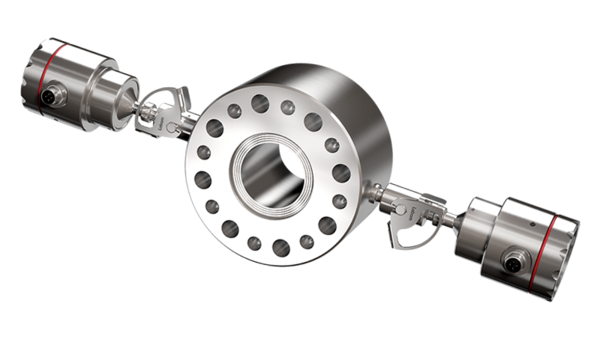
Hygienic use of diaphragm seals
Hygienic and aseptic applications
In addition to standard solutions compliant with industry standards, Labom also implements manufacturer specifications and bespoke customer solutions. In accordance with the principles of hygienic design, the company guarantees ease of cleaning, high reliability and no interference with the product. Labom achieves this high level of hygienic quality by avoiding structural dead spaces, gaps and edges, selecting suitable materials and creating surfaces with low roughness. In terms of structural design, flush coupling of components and a self-emptying design are also required or helpful. On customer request, an even higher surface finish can be achieved through electropolishing. Other industries can also benefit from these specialised designs. For example, the absence of gaps and dead spaces is also required in the paint industry to minimise cleaning cycles between colour changes.
Requirements for hygienic design
Hygienic connections
A range of Labom diaphragm seals has been certified by the European Hygienic Engineering & Design Group (EHEDG) as suitable for SIP and CIP applications. The certification covers models compliant with DIN 11864 featuring flange, clamp or
screw connections, as well as Varivent® and NEUMO BioConnect® diaphragm seals. In addition, a wide range of other clamp connections or solutions with union nuts are available for applications with less stringent requirements.
Transmission fluids
As a specialist manufacturer of pressure transmitters for hygienic and aseptic processes, Labom uses a pressure transmission fluid as standard that complies with the internationally recognised hygiene standards of the FDA (Food and Drug
Administration). For special applications, further hygiene-compliant pressure transmission fluids are available, including medical white oil, deionised water and a water-glycerine mixture.
EHDG certification types
TYPE EL – Components cleaned with liquids
| EL Class I | Components for closed processes: cleaning-in-place (CIP) without dismantling |
| EL Class I AUX | Components in open processes, cleaning without dismantling |
| EL Class II | Components for closed or open processes, after dismantling |
| EL Aseptic Class I | Components for closed processes: cleaning-in-place (CIP) without dismantling, steam-sterilisable and impervious to bacteria |
| EL Aseptic Class II | Components for closed processes following disassembly; steam-sterilisable and impermeable to bacteria once reassembled |
Related articles
Outstanding innovation, 2nd place!

REconnect quick coupling device
Diaphragm seal testing device: Testing diaphragm seals without opening the process