Hygienic requirements
Smooth surfaces
The structure and roughness of a surface are crucial factors in the removal of dirt and microorganisms. Only a flawless surface, free from scratches, pores, crevices and cracks, can be cleaned and sterilised using automated processes.
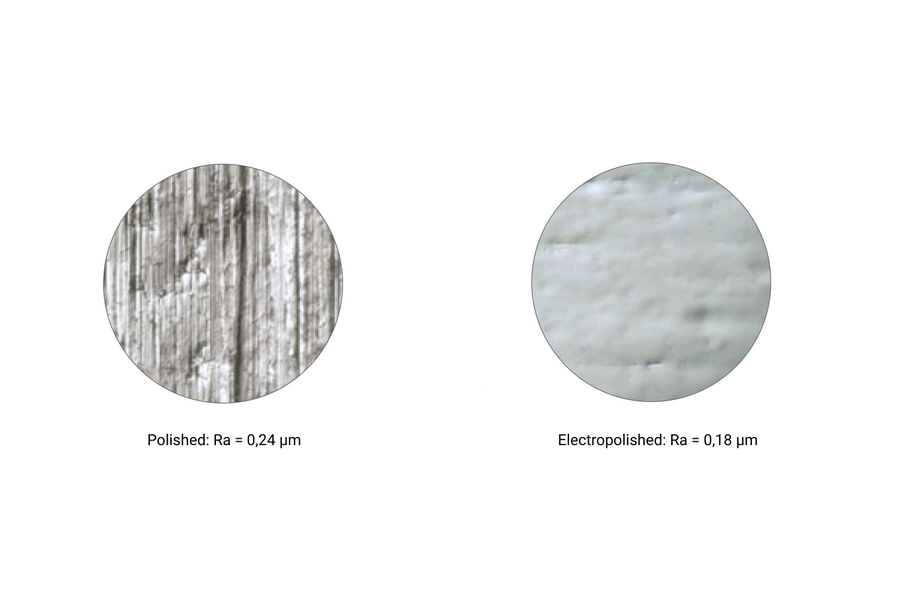
Our laser weld seams generally have a low surface roughness. In general, an average value of Ra < 0.8 μm on smooth surfaces and in weld seam areas is sufficient. Below Ra=0.4 μm, no improvement in cleanability is to be expected. Labom devices in hygienic design is supplied for areas in contact with products with the surface roughness classes shown opposite. Electropolishing does not necessarily improve roughness, but it does create a homogeneous passive layer with lower adhesion for dirt.
We manufacture the surfaces of turned parts and diaphragms in accordance with ASME BPE SFx
| Code | HY ≤ SF3 | HY06 ≤ SF1 | HY04 ≤ SF4 |
| Turned components | Ra ≤ 0,76 μm | Ra ≤ 0,51 μm | Ra ≤ 0,38 μm + E-poliert |
| Diaphragm foil | Ra ≤ 0,38 μm | Ra ≤ 0,38 μm | Ra ≤ 0,38 μm + E-poliert |
| Weld seam | Ra ≤ 0,76 μm | Ra ≤ 0,76 μm | Ra ≤ 0,76 μm + E-poliert |
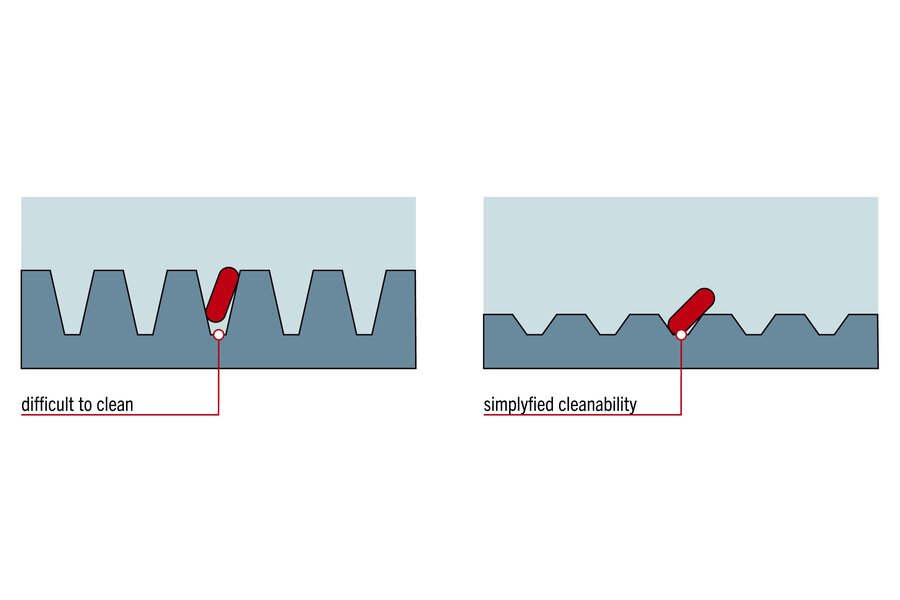
No gaps or edges
It’s the design that makes the difference: when ensuring that systems and equipment fulfil the purpose for which they were originally designed, hygiene requirements can sometimes conflict with functional necessities. There should be no gaps or sharp edges, yet at the same time the equipment must operate optimally. In the search for an acceptable compromise, hygiene safety always takes priority. Labom has extensive experience in the process industry and offers a wide range of hygienic and aseptic process connections.
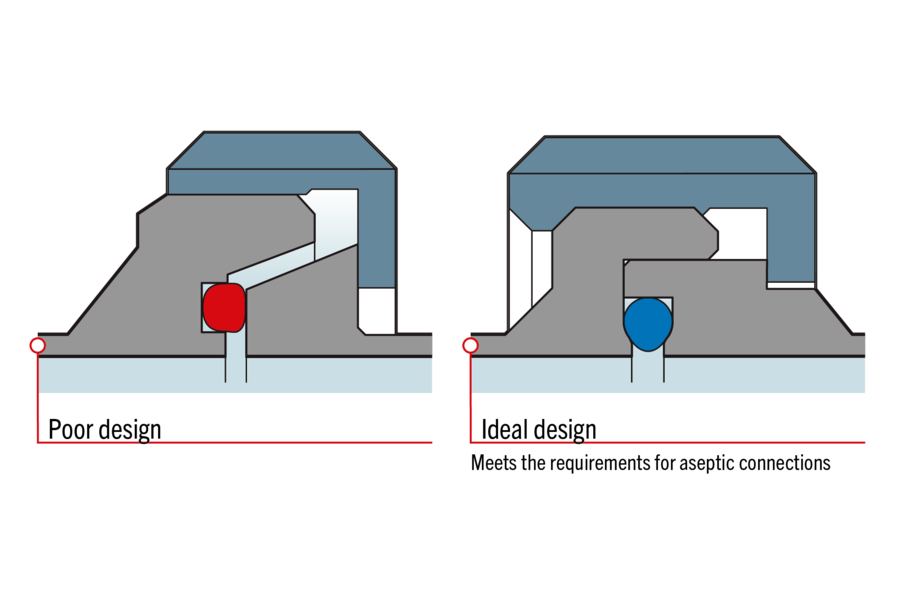
Features of aseptic process connections
- Self-centring via a cylindrical guide creates a gap-free seal on the inside of the pipe
- A metal stop ensures the seal is pressed into place with the correct force
- Space is provided for thermal expansion of the seal on the side facing away from the process
No dead zones
Dead zones arise, for example, due to abrupt changes in diameter or blind pipe ends. A hygienic design of measuring points should aim to avoid dead zones, as these can lead to problems during cleaning. As a general rule, the higher the flow velocity of a cleaning agent, the better the result.
To achieve optimum flow, better solutions must be chosen for the local geometry. Ideally, there should be no dead zones at all.
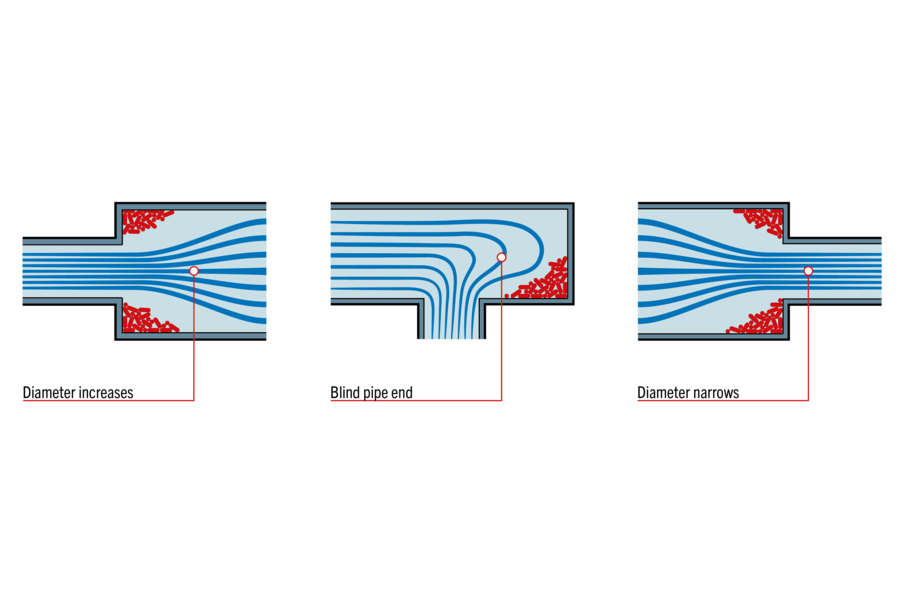
Solution for dead-zone-free measurement
- Pressure measurement using a inline diaphragm seal (part of the pipework)
- Temperature measurement using a pipe sensor (part of the pipework)
- Surface temperature measurement (external / clamp-on technology)
Self-emptying
Self-emptying is a key issue in plant and piping design. The EHEDG’s recommendations on this matter are as follows: “The internal and external surfaces of all equipment, components and pipework must be self-emptying or drainable and easy to clean. Horizontal surfaces must be avoided; they should always be inclined towards one side. In the case of external surfaces, this should be designed in such a way that any liquids flow away from the product area.”
The right materials
Stainless steel
Stainless steel offers excellent corrosion protection under the process conditions typical of applications in the food, pharmaceutical and biotechnology sectors. The selection of the appropriate stainless steel for a given application depends largely on the corrosiveness of the process and the cleaning agents used. Other relevant factors include stress levels, machinability and formability, weldability, hardness and cost (see also the EHEDG recommendation on construction materials, Doc 32).
Stainless steels used
- Housing made of stainless steel 1.4301 (304) and 1.4401 (316)
- Parts in contact with the medium: stainless steel 1.4404 and 1.4435 (316L)
- Higher-grade stainless steels available on request, e.g. in accordance with the Basel standard BN2 or with a reduced delta ferrite content
Fluids and oils
- Standard pressure transmission fluid: FDA-listed silicone-free synthetic oil
- Other options: medical white oil (FDA-listed), glycerine/water
Seals
Measuring devices and equipment components are adapted to the process using tried-and-tested connection technology that incorporates seals. A seal must fulfil its function throughout its entire service life, taking into account all process and cleaning procedures. It can be designed as an O-ring or as a moulded seal.
Requirements
The seals must demonstrate mechanical and chemical resistance to the product and cleaning agents within the specified temperature range. Furthermore, controlled compression must be ensured, taking into account the thermal expansion of the
sealing material. Smooth surfaces to reduce particle adhesion, sufficient elasticity, and colour and taste neutrality are further requirements that must be taken into account in accordance with regulations and guidelines.
Related articles
Outstanding innovation, 2nd place!
Diaphragm seal testing device: Testing diaphragm seals without opening the process
Modular system of diphragm seals