SIL – on the safe side
How is a measuring device qualified for SIL?
In order to qualify measuring devices in accordance with the SIL standard DIN EN 61508, numerous organisational measures, control mechanisms and software requirements – where applicable – must be met behind the scenes. In addition, determining the functional safety levels is essential. These are incorporated into the plant operators’ functional safety calculations. There are two possible methods for determining these levels.
Determination of functional safety parameters using FMEDA
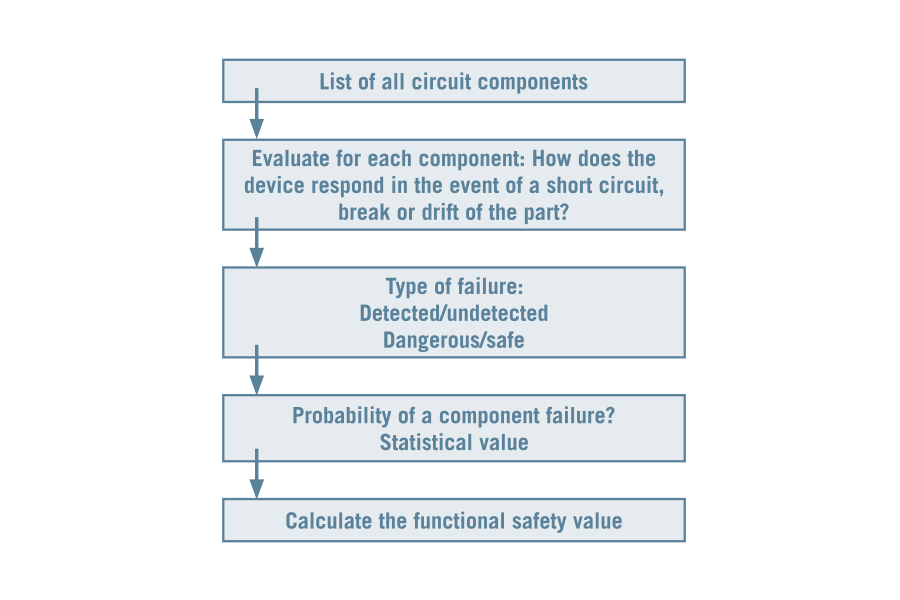
In an FMEDA (Failure Modes, Effects and Diagnostics Analysis), all components relevant to safe operation are identified. The consequences of a failure are then assessed for each individual component. A distinction is made between:
- Open circuit (= break in the electrical circuit)
- Short circuit
- Drift
For each of these conceivable faults, an assessment is made of how the behaviour of the measuring device affected. Does it continue to measure? Does it remain within its specified accuracy? Is there an impact on response times? Based on the effects, it can be determined whether the failure is dangerous (affecting safe operation) or non-dangerous (no impact on safe operation). It is then checked whether a component failure would be detected – because a system can react to detected faults; the main problem lies with undetected faults. To assess the probability of a component failure, one can refer to published empirical values or to the manufacturer’s specifications. These considerations now provide the basis for calculating the functional safety metrics in accordance with DIN EN 61508 – for example, the rates of dangerous failures, the probability of failure on demand (PFD) or the safe failure fraction (SFF).
Determination of functional safety values through in-service performance
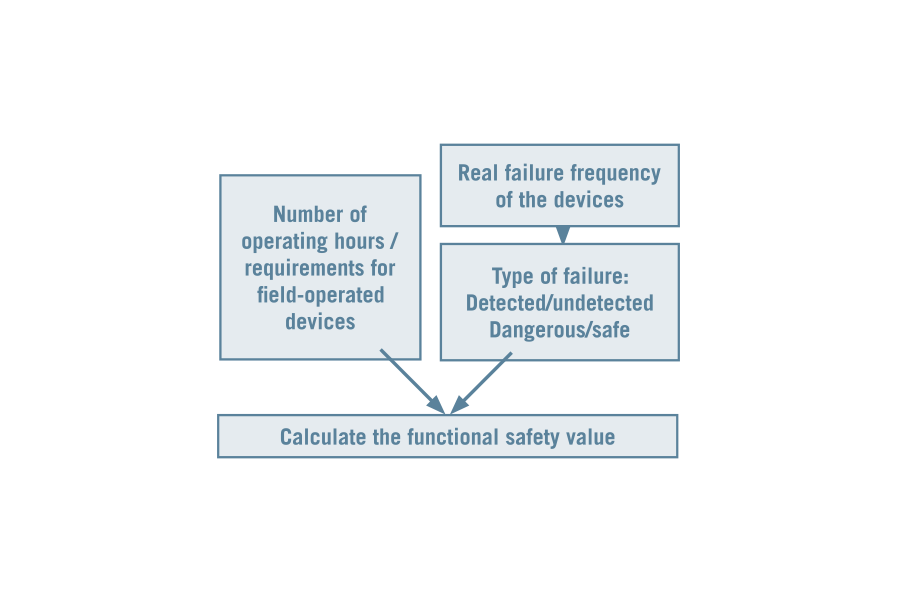
Field performance is based on experience gained from a large number of devices already in use. The DIN EN 61508 standard specifies the minimum number of operating hours or safety function requirements that must be met in order to satisfy the criteria for field performance. In concrete terms, this involves evaluating data on operating hours in the field and any faults that may have occurred (there aren’t many of those, after all). Any faults observed are categorised as safe or unsafe, and detected or undetected. This data then forms the basis for calculating the functional safety values in accordance with DIN EN 61508.